Literature Review & Requirements
- Research & Modeling: Conducting a comprehensive narrative literature review on motion planning, kinematic modeling, and control approaches for articulated and non-holonomic mobile robots.
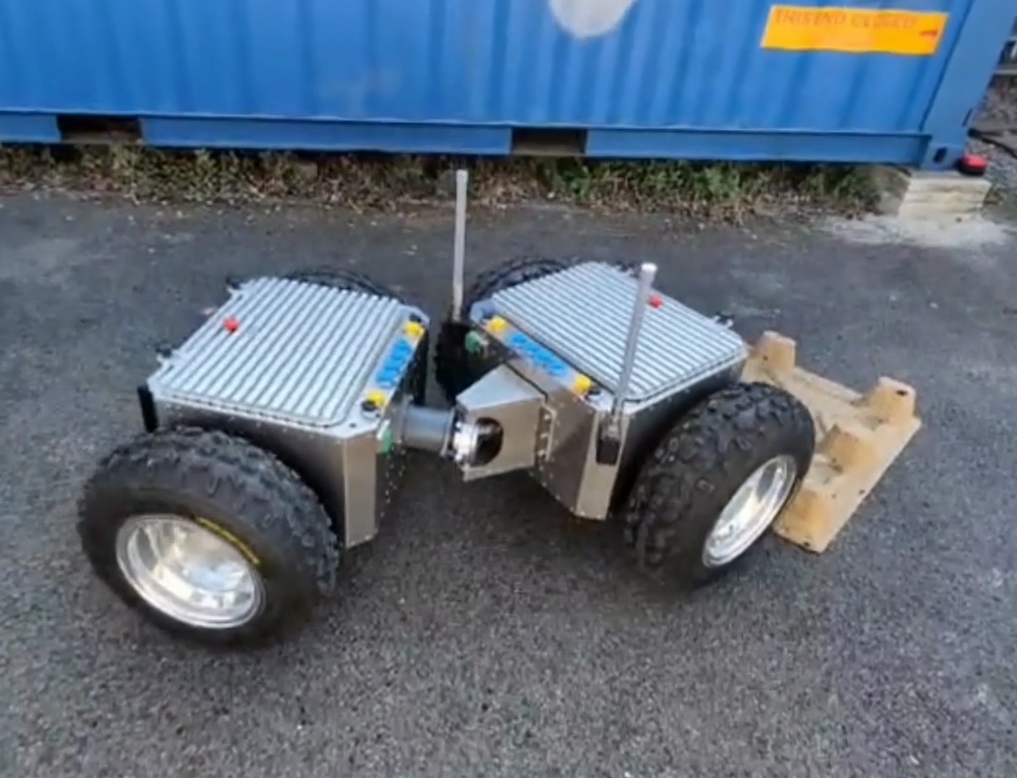
- Dual-Body Focus: Focusing specifically on dual-body platforms formed by two differential-drive units and investigating established techniques such as lattice-based planning, Hybrid-A*, and articulated-kinematic modeling.
- System Criteria: Defining comprehensive functional requirements and necessary criteria for kinematic consistency, articulation-aware trajectory generation, and collision avoidance based on these findings.
Framework Adaptation & MRG-SLAM Integration
- Nav2 Architecture: Adapting an existing ROS 2-based navigation framework to handle the non-holonomic constraints of dual-body systems.
- Localization: Leveraging an existing multi-robot graph simultaneous localization and mapping (MRG-SLAM) algorithm to maintain robust mapping.
- Hinge-Aware Mechanics: Extending specific components to natively support an articulated motion model, including hinge-aware collision checking and specialized trajectory planning strategies.
Implementation & Physical Deployment
- ROS 2 Integration: Implementing the adapted framework directly within a ROS 2 environment by actively integrating planning modules and articulation-state mechanisms into the Navigation2 (Nav2) stack.
- Hardware Deployment: Deploying the navigation components onto the physical dual-body robotic hardware.
- Low-Level Communication: Adapting robot interfaces, verifying communication with low-level controllers, and ensuring compatibility with the onboard MRG-SLAM system to prepare for real-world experimental validation.
Validation & Experimental Analysis
- Simulation & Real-World Trials: Validating the framework and internal dependencies through extensive simulations and controlled outdoor experiments.
- Quantitative Metrics: Performing validation using metrics such as trajectory fidelity, hinge evolution, and collision-free operation to rigorously assess navigation accuracy, articulation dynamics, and obstacle-avoidance behavior.
- System Evaluation: Analyzing experimental results to determine the robustness and practical applicability of the framework, and formulating recommendations for potential extensions to more complex articulated platforms and broader deployment scenarios.