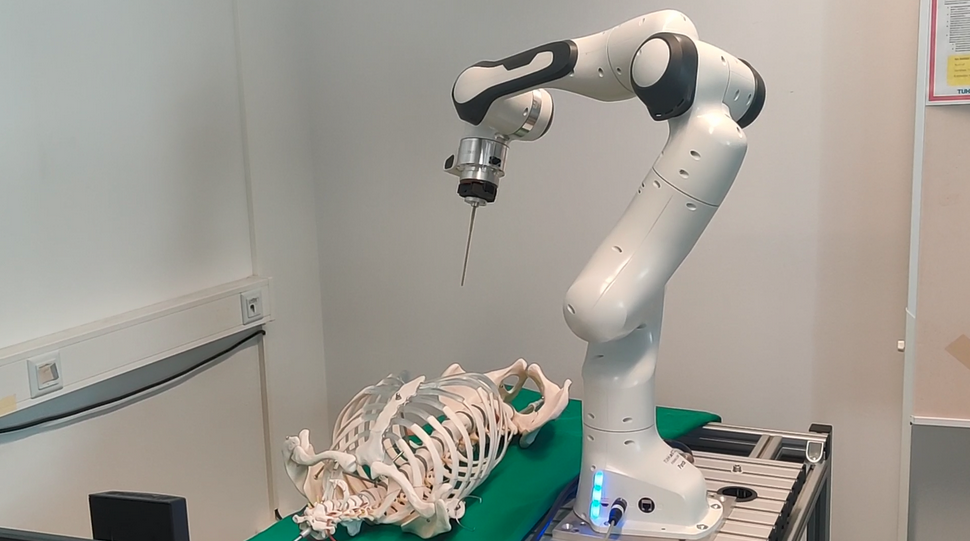
Overview & Course Context
Developed as part of the "Robotics and Navigation in Medicine" course at TUHH (MTEC), this project aimed to simulate and execute a modern image-guided robotic surgery. The primary objective was to accurately identify a tumor's position and autonomously maneuver a 7-axis Franka Emika robotic arm to perform a minimally invasive needle biopsy.
Project Structure
The development was split between two specialized sub-teams: Vision and Robotics. I focused entirely on the Robotics aspect.
- Vision Team: Handled depth camera calibration and image processing to output two critical 3D spatial coordinates: the target tumor location and the optimal entry point on the patient to minimize tissue damage.
- Robotics Team (My Role): Responsible for translating those 3D coordinates into smooth, safe, and precise physical movements of the robotic manipulator.
Trajectory Planning & Control
Safe medical robotics requires mathematically continuous and jerk-free motion. To achieve this, our team implemented the underlying motion control architecture using ROS and Python.
- Trajectory Algorithms: We wrote two different trajectory planning algorithms—Quintic Polynomials and LSPB (Linear Segment with Parabolic Blends). We evaluated both approaches and chose the better-performing one to guarantee continuous position, velocity, and acceleration profiles, eliminating abrupt hardware jerks during operation.
- Straight-Line Interpolation: Engineered custom interpolation algorithms to constrain the needle's path to a strict straight line from the entry point to the tumor, which is critical for minimizing surgical invasiveness.
- ROS Node Integration: Encapsulated the planning logic within a dedicated ROS node to handle the dynamic pose targeting and execution seamlessly.
Challenges & Implementation
- Manual Inverse Kinematics: Instead of relying on high-level abstractions like MoveIt, the inverse kinematics for the 7-axis arm were calculated and implemented manually. This provided a much deeper understanding of redundant manipulator motion and singularity avoidance.
- Sim-to-Real Gap: Bridging the gap between RViz simulations and the physical Franka robot required rigorous debugging. Motions that appeared flawless in simulation occasionally triggered safety limits on the real hardware, demanding iterative refinements to the trajectory parameters.